
Lamp for Linotype-Hell or rather Heidelberg Topaz Scanner NEC FL15AD-70
Article number: 32571
Listed in category: Scanner / Spareparts > Lamp for Linotype-Hell or rather Heidelberg Topaz Scanner NEC FL15AD-70 from brakensiek.de
Lamp for Heidelberg Topaz scanner of Linotype-bright/Heidelberg
Supervision / Reflection
Examination / Transparency
Light production with fluorescent lamp
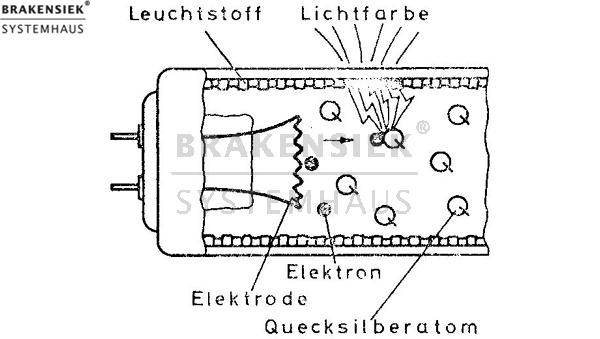
Fluorescent lamps are filled with mercury steam and have heatable electrodes at the ends.
The inside wall of the glass pipe is coated with illuminants which shine at company of the fluorescent lamp in certain light colours.
Hence, the name Fluorescent lamp (light emitter)
The light colours are determined by the kind of the gas filling and the illuminant.
The life span of a fluorescent lamp amounts to about 7000 fuel hours with about 2000 circuits.
If the fluorescent lamp is switched very often, the life span sinks.
The light yield compared with an electric light bulb amounts to the about fold one 3-6 with the same achievement.
Fluorescent lamps have no passageway between the electrodes, so the stream must flow by the gas filling through. However, in addition the gas must be moved only into a leading state
So that the stream flows by the fluorescent lamp,
if the Qecksilberdampffüllung becomes by a starter and throttle
causing high-tension push ionises and with it leading-able.
The stream by the Qecksilberdampffüllung generates the visible,
pale blue light and a substantially stronger however invisible ultraviolet light radiation.
This ultraviolet light cannot penetrate the glass wall,
however, it stimulates the Leuchstoffschicht right within the glass pipe to the luminous one
Impact of the fluorescent lamp
So that the stream flows by the fluorescent lamp,
if the Qecksilberdampffüllung becomes by a starter and throttle
causing high-tension push ionises and with it leading-able.
After him the mercury steam has caught fire, his opposition becomes small
and with it the stream by the lamp very largely.
So that the lamp is not destroyed, the strong stream increase has to go
are prevented by a preswitch device.
Therefore, fluorescent lamps need additional company means for her flawless company:
An ignition equipment (starter) and a preswitch device (Drosssel).
Circuit principle of the fluorescent lamp
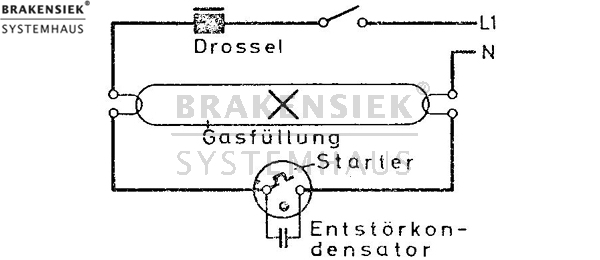
How it is to be seen from the stream run plan (on top), the fluorescent lamp is switched with the preswitch device in row.
In parallel with the fluorescent lamp lies the starter which lights the fluorescent lamp.
The condenser lying in parallel with the starter serves predominantly for the noise suppression.
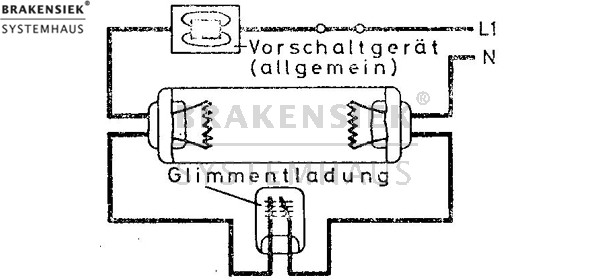
After turning on of the net counter the mains voltage lies between L1 and N over preswitch device and electrodes (spiral) with the Glimmlampe of the starter.
The noble gas in the Glimmlampe catches fire, there flows a small stream.
By the caused Glimmladung the electrodes of the Glimmlampe warm themselves up.
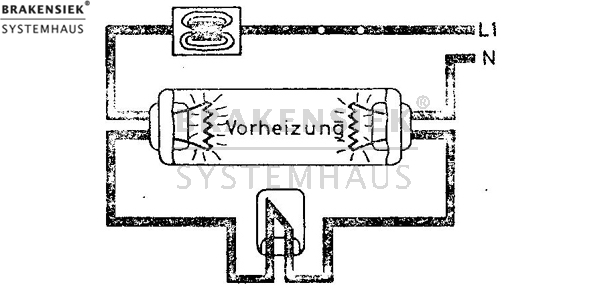
By the warming the electrodes existing of Bimetall curve in the starter and touch.
Thereby it is short-circuited the Glimmlampe.
Now a high stream (the about 1.5 fold lamp stream) from the outer conductor L1 flows over the preswitch device, about the 1st electrode, by the short-circuited starter and about the 2nd electrode to the neutral leader N.
In the preswitch device a strong magnetic field is based. The metal spirals (electrodes) in the fluorescent lamp are heated.
The electrodes are provided with a paste,
from itself with warming electrons can easily solve.
Because the short-circuited Glimmlampe does not shine in the starter any more, it cools off.
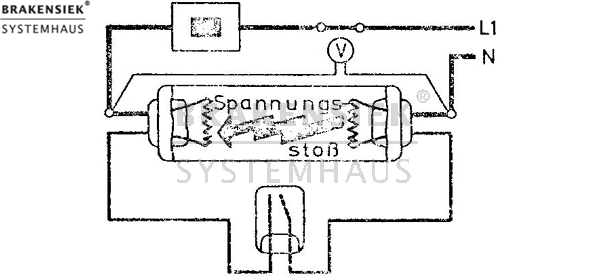
The Glimmlampenkontakte open, the circuit is interrupted.
The strong magnetic field in the preswitch device breaks down.
This entails that the preswitch device delivers a big tension push to the electrodes of the fluorescent lamp by the induction effect.
The big tension push (600 V to approx. 2000V) brings the electrons resigning from the electrodes on a big speed.
They bang into mercury atoms, thereby hit other electrons herraus and make the mercury atoms also leading.
The gas filling within the fluorescent lamp becomes leading.
The fluorescent lamp has caught fire.
The stream of the fluorescent lamp rises avalanche-like. Now the preswitch device works as stream limiter (throttle), the fluorescent lamp shines.
The fuel tension with a 36W-lamp approx. 103V.
The Glimmlampe in the starter cannot shine because has become too small power on the Glimmelektroden.
Remark:
The starter can initiate only the ignition of the lamp if he receives the "start tension" from 180 V. Only with this tension it is sure that the starter closes his contacts and opens while cooling off.
Spring: www.transistornet.de
Supervision / Reflection
Examination / Transparency
Light production with fluorescent lamp
Fluorescent lamps are filled with mercury steam and have heatable electrodes at the ends.
The inside wall of the glass pipe is coated with illuminants which shine at company of the fluorescent lamp in certain light colours.
Hence, the name Fluorescent lamp (light emitter)
The light colours are determined by the kind of the gas filling and the illuminant.
The life span of a fluorescent lamp amounts to about 7000 fuel hours with about 2000 circuits.
If the fluorescent lamp is switched very often, the life span sinks.
The light yield compared with an electric light bulb amounts to the about fold one 3-6 with the same achievement.
Fluorescent lamps have no passageway between the electrodes, so the stream must flow by the gas filling through. However, in addition the gas must be moved only into a leading state
So that the stream flows by the fluorescent lamp,
if the Qecksilberdampffüllung becomes by a starter and throttle
causing high-tension push ionises and with it leading-able.
The stream by the Qecksilberdampffüllung generates the visible,
pale blue light and a substantially stronger however invisible ultraviolet light radiation.
This ultraviolet light cannot penetrate the glass wall,
however, it stimulates the Leuchstoffschicht right within the glass pipe to the luminous one
Impact of the fluorescent lamp
So that the stream flows by the fluorescent lamp,
if the Qecksilberdampffüllung becomes by a starter and throttle
causing high-tension push ionises and with it leading-able.
After him the mercury steam has caught fire, his opposition becomes small
and with it the stream by the lamp very largely.
So that the lamp is not destroyed, the strong stream increase has to go
are prevented by a preswitch device.
Therefore, fluorescent lamps need additional company means for her flawless company:
An ignition equipment (starter) and a preswitch device (Drosssel).
Circuit principle of the fluorescent lamp
How it is to be seen from the stream run plan (on top), the fluorescent lamp is switched with the preswitch device in row.
In parallel with the fluorescent lamp lies the starter which lights the fluorescent lamp.
The condenser lying in parallel with the starter serves predominantly for the noise suppression.
After turning on of the net counter the mains voltage lies between L1 and N over preswitch device and electrodes (spiral) with the Glimmlampe of the starter.
The noble gas in the Glimmlampe catches fire, there flows a small stream.
By the caused Glimmladung the electrodes of the Glimmlampe warm themselves up.
By the warming the electrodes existing of Bimetall curve in the starter and touch.
Thereby it is short-circuited the Glimmlampe.
Now a high stream (the about 1.5 fold lamp stream) from the outer conductor L1 flows over the preswitch device, about the 1st electrode, by the short-circuited starter and about the 2nd electrode to the neutral leader N.
In the preswitch device a strong magnetic field is based. The metal spirals (electrodes) in the fluorescent lamp are heated.
The electrodes are provided with a paste,
from itself with warming electrons can easily solve.
Because the short-circuited Glimmlampe does not shine in the starter any more, it cools off.
The Glimmlampenkontakte open, the circuit is interrupted.
The strong magnetic field in the preswitch device breaks down.
This entails that the preswitch device delivers a big tension push to the electrodes of the fluorescent lamp by the induction effect.
The big tension push (600 V to approx. 2000V) brings the electrons resigning from the electrodes on a big speed.
They bang into mercury atoms, thereby hit other electrons herraus and make the mercury atoms also leading.
The gas filling within the fluorescent lamp becomes leading.
The fluorescent lamp has caught fire.
The stream of the fluorescent lamp rises avalanche-like. Now the preswitch device works as stream limiter (throttle), the fluorescent lamp shines.
The fuel tension with a 36W-lamp approx. 103V.
The Glimmlampe in the starter cannot shine because has become too small power on the Glimmelektroden.
Remark:
The starter can initiate only the ignition of the lamp if he receives the "start tension" from 180 V. Only with this tension it is sure that the starter closes his contacts and opens while cooling off.
Spring: www.transistornet.de
Contact:
Your contact person: Tim Brakensiek
used products
last update:
07.02.2012


